
From Detroit Steel to the Silver Arrows: ACSI, Formula 1, and the Race for Automotive Quality
Sarah Jane Lefebvre, Marketing Content Lead

There are generally two ways to appreciate motorsport: the first is in the mechanics, precise engineering pulling extra hundredths of a second from a car’s engine, and the second is in the human history, the drivers and the near-impossible moments that last generations. Enjoying a Formula 1 season often involves a love for both. For the current generation of fans, understanding Max Verstappen’s ongoing and vocal frustration with 2026 FIA regulation changes necessitates an equal recognition of both his legendary performance during the DRS era (drag reduction, for those new to the sport) and insight into how a regulated split between combustion and electric power affects the way the cars are built and driven. In essence, motorsport and automotive manufacturing are where the human and mechanical intersect.
Reflecting on automotive history, Michigan sits in the middle of this joint understanding. In the Motor City, Cadillac helped to define precision manufacturing at the dawn of the automotive age. Decades later, Mercedes-Benz embedded itself in Ann Arbor to refine engineering and adapt global products to domestic American expectations. And in 1994, the American Customer Satisfaction Index (ACSI®) was founded not to measure what cars (and other American goods and services) are but rather how they function in the lives of those who drive them. Together, these histories tell a story that stretches from the early Detroit assembly lines to the F1 grid and illustrates how attention to quality, reliability, and value evolve from engineering concepts and expectations into the lived experiences that ultimately define success.
Cadillac and Mercedes-Benz as Two Interpretations of Excellence
Motor vehicle quality in 1902 when the Cadillac Automobile Company was founded in Detroit was largely perceived as purely mechanical. The manufacturer’s early leadership in the development of interchangeable parts helped set durability, precision, and standardization as benchmarks for automotive quality, but by the late 20th century, customer needs were more multifaceted and automotive expectations far higher. When the ACSI launched from the University of Michigan, it introduced a system of measurement that reframed quality as something multidimensional, intended to capture how perceptions and expectations of performance and cost evolve as manufacturers innovate.
What Michigan produced, then, wasn’t just a whole nation’s worth of cars but also a framework for understanding how those cars are experienced, especially as the expectations of their performance change.
At its core, the ACSI model links customer expectations, perceived quality (including reliability), and perceived value to overall satisfaction and loyalty. From this perspective, Cadillac and Mercedes-Benz are more than just competitors, now both off and on the grid; they are case studies in separate paths toward customer satisfaction.
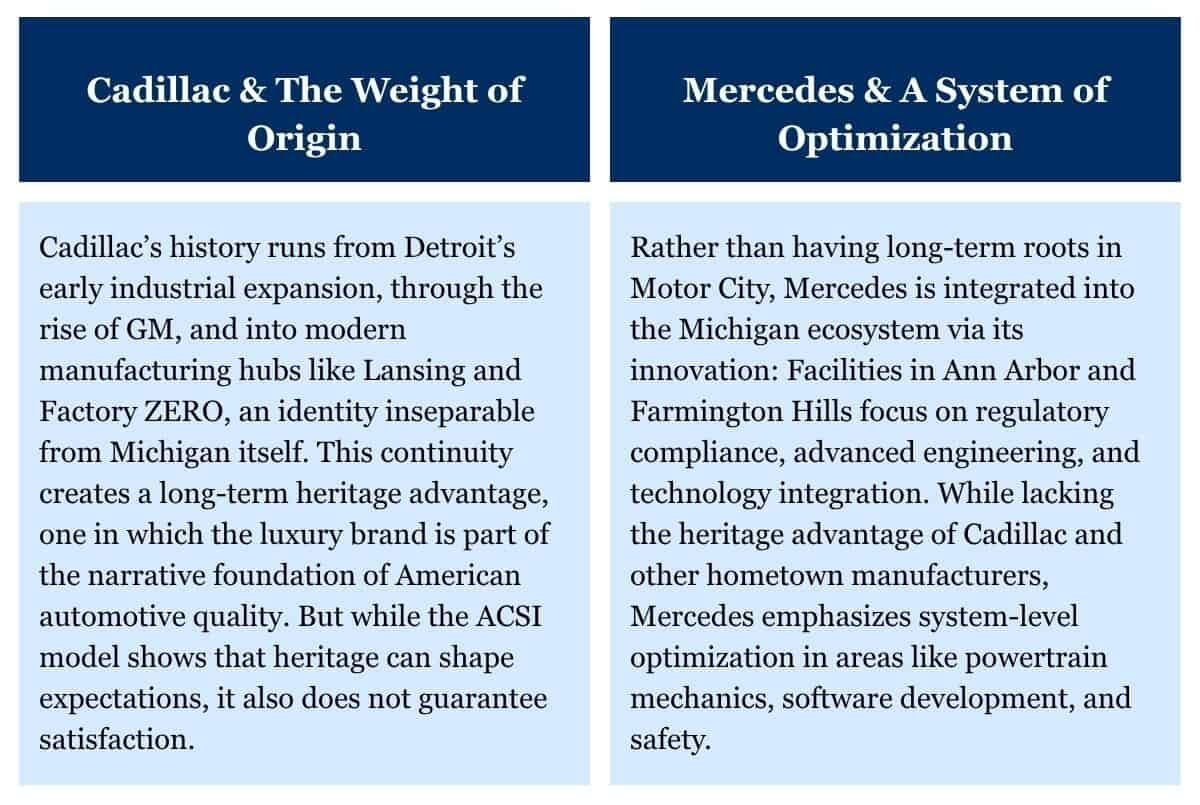
In an era defined by rapid changes in electrification, in-vehicle technology, digital interfaces, and ownership experience, the challenge is to translate legacy and long-term customer expectations into contemporary perceived value. Cadillac customers evaluate the brand and vehicle experience against their expectations, their other options, and their ideal experience, not its storied past. Here, Mercedes’s engineering-first approach translates into stronger customer perceptions. In working directly on drivers that shape a customer’s perceived quality, reliability, and satisfaction with technology integration, the brand seeks to execute across the full ownership experience.
Compressing the Grid into Customer Satisfaction
And now for the fun part as a motorsport fan, because if the ACSI is a structured model of satisfaction, F1 is a real-time extreme, and the contrast between the two race teams this year is intentionally stark.
In its debut season, Cadillac focuses on organizational development and reliably engineering a vehicle that can earn points. Mercedes, by contrast, leads Constructors with 333 points and looks for consistency in its power units to keep their drivers on the podium. While this is, at its core, a distinction between race teams at two different levels of organizational maturity, it reflects some of the same underlying dynamics between expectations of performance and value and real results that ACSI measures in consumer markets.
In Formula 1 terms, expectations are shaped by prior performance and investment, perceived quality is reflected in raw pace and technical execution, and perceived value emerges from the tradeoff between performance gains and reliability risk. Quality, reliability, and value directly impact the raw performance, race completion, and relative results of each of the cars on the grid. DNFs due to breakdowns, analogous to consumer product defects, can have long-term effects on perceptions of driver and team quality, especially as they become more infrequent. And while Mercedes drivers Russell and Antonelli have seriously struggled with the reliability of their cars’ fragile battery architecture, those setbacks, much like in consumer markets, are relative. In the 2026 season so far, Mercedes gave up about 43 points on reliability issues alone. The team’s next closest competitor, Ferrari, gave up only 10 and yet sits 77 points behind Mercedes in Constructors. This is a wide margin, but multiple race retirements for reliability give other teams a chance to narrow the gap.
Just as in consumer markets, regulation changes, competitor innovations, and differences in driving style affect comparative expectations of performance and introduce ever-evolving criteria for success. This is where the ACSI value equation kicks in: the differential in speed that an adjustment to the car’s front wing, power unit, or intakes provides must outweigh the cost of both an FIA review and any potential mechanical unreliability. Identifying team or manufacturer-specific success criteria, then, and measuring against that outcome matrix is critical. Otherwise, manufacturers, both on and off the grid, risk that investments for short-term performance will lack a long-term return on satisfaction.
Much like in the ACSI consumer model, this experiential equation is heavily influenced by those expectations of performance. Dominant teams maximize the energy they harvest from their inputs while new entries endeavor (and are expected) to convert financial investment into real results in the form of P1 and P2 finishes. Thus far, Mercedes, despite its reliability issues, has found that value alignment, with either Russell or Antonelli on the podium of every 2026 GP so far.
P1 as a Moving Target
What links all of these narratives together is the evolution of expectations over the course of automotive history. ACSI’s founding insight is that satisfaction is dynamic, adapting as the nation changes, technology advances, and consumers recalibrate their expectations of what great performance looks like. Heritage alone is insufficient to meet expectations when it often sets them.
As an automotive manufacturer, Cadillac’s history of innovation and Michigan roots set an expectation of quality behind the wheel the brand must meet among its customers. Similarly, Mercedes’s history of excellence as a race team sets an expectation of podium results among both fans and investors. And neither the manufacturer nor the team exists in isolation: they compete among a field of other constructors looking to outperform. Thus, today’s innovation becomes tomorrow’s benchmark, and yesterday’s results just simply aren’t enough.
In a sport where fractions of a second determine success, there’s no room for static advantage. Engineering excellence must be an ongoing process. Quality reliability, and the interplay within the value equation are just as critical for F1 teams as they are for automotive manufacturers. As technology, competition, and consumer expectations continue to evolve, understanding how people experience performance remains as important as the engineering behind it. For over four decades, ACSI has measured those changing expectations across American industries, offering a window into the factors that shape customer satisfaction and loyalty. Just as in consumer markets, sustained performance and reliability translate into loyalty- whether that’s repeat purchases for automakers or enduring fan and sponsor support for F1 teams. And in that sense, the distance between a Detroit assembly line and the Belgium GP grid is shorter than it seems.