
The American Customer Satisfaction Index (ACSI®) is designed to identify changes in customer satisfaction that are most closely associated with customer retention. Strong and improving loyalty can support revenue growth and profitability while reducing business risk. The ACSI Leaders portfolio applies this signal by selecting 30 to 35 of the highest-scoring companies within their industries and weighting them based on the relationship between satisfaction and retention. Historically, this approach has produced above-market returns with lower downside sensitivity.
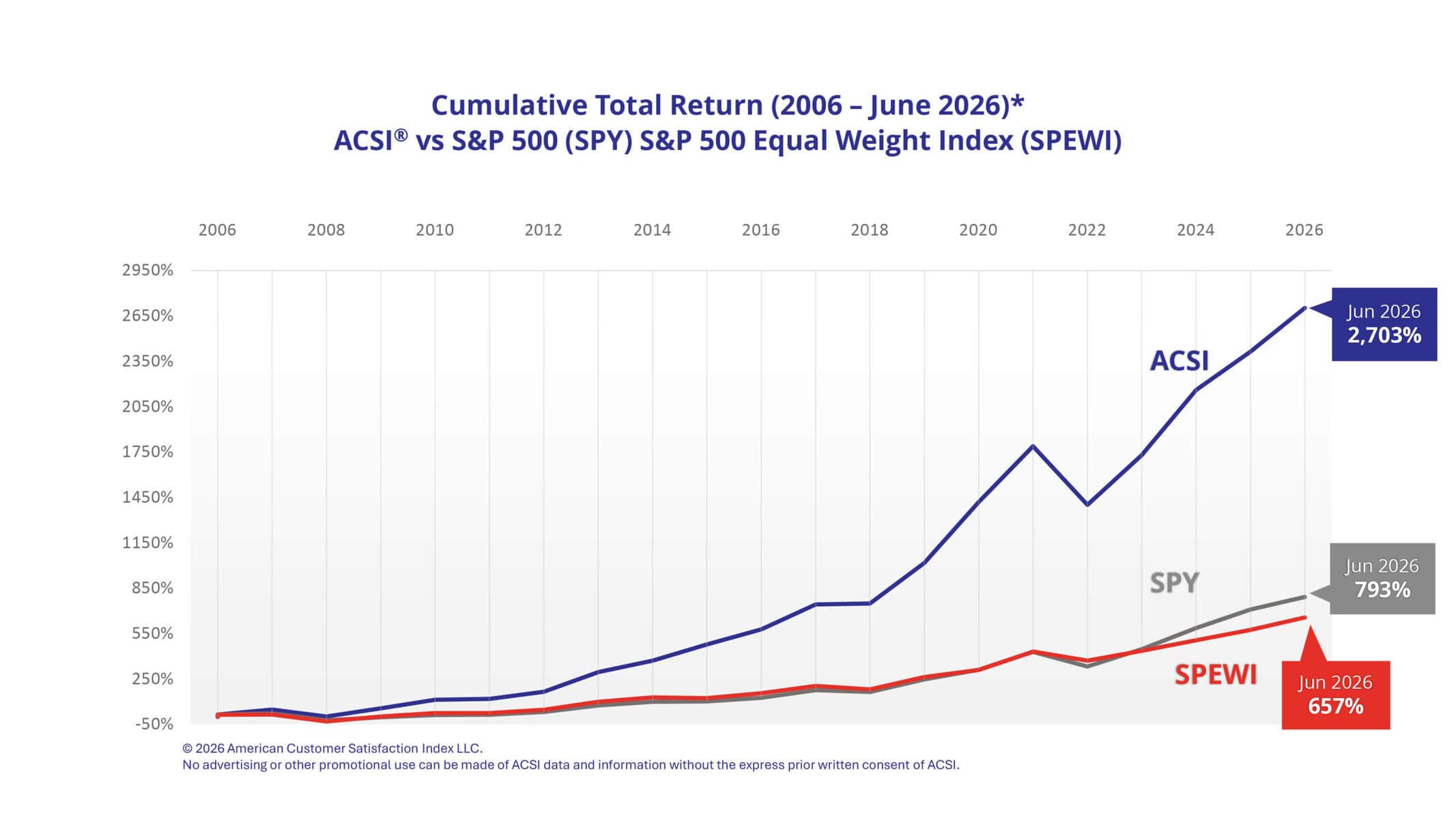
From January 2006 through June 2026, the ACSI Leaders portfolio generated a cumulative total return of 2,703%, compared with 793% for the S&P 500 and 657% for the S&P 500 Equal Weight Index. These results correspond to annualized returns of 17.7% for ACSI Leaders, 11.3% for the S&P 500 and 10.4% for the equal-weight index.
Why benchmark choice matters
The cap-weighted S&P 500 has become increasingly concentrated in its largest companies, with performance heavily influenced by mega-cap technology and the AI and data-center investment cycle. That structure can make it a less representative benchmark for portfolios that do not share the same sector and style exposures. The S&P 500 Equal Weight Index therefore provides a useful complementary comparison.
Performance since 2023
From January 2023 through June 2026, the ACSI Leaders portfolio gained 86.6%, compared with 59.8% for the S&P 500 Equal Weight Index, a lead of 26.8 percentage points. Risk-adjusted results also favored ACSI over this period. Its Sharpe ratio was 1.07 versus 0.83 for equal weight, while its Sortino ratio was 2.24 versus 1.43. Importantly, the ACSI leadership portfolio showed an up-market beta of 1.09 and a down-market beta of 0.81, and the portfolio captured approximately 68% of the equal-weight index's downside. The underlying mechanisms on consumer loyalty and retention created a surfing beta that not only participated, but benefitted from up market moves, while providing some downside protection.
First-half 2026 results
The ACSI Leaders portfolio gained 11.5% during the first half of 2026, compared with 10.2% for the S&P 500 and 12.1% for the S&P 500 Equal Weight Index. ACSI therefore outperformed the cap-weighted benchmark by 1.3 percentage points while trailing equal weight by 0.7 percentage points.
Stock selection was the principal source of relative value against the S&P 500. The attribution analysis shows a 6.45 percentage-point selection benefit, which more than offset a 3.97-point allocation drag. Selection was especially strong in Information Technology and Health Care. Those sectors contributed 2.74 and 2.87 percentage points of total relative attribution, respectively, while Financials added another 0.88 points. In Technology, strong company selection overcame the effect of a substantial benchmark underweight.
The largest offsets came from Consumer Discretionary and Communication Services. Consumer Discretionary detracted 3.18 percentage points, reflecting both an overweight to a lagging sector and weak stock selection. Communication Services detracted 1.19 points, while the portfolio's lack of Energy exposure reduced relative return by 0.63 points.
Results were also concentrated at the company level. Dell Technologies was by far the largest contributor, adding 6.54 percentage points to portfolio return. Humana added 1.66 points, followed by Alphabet at 1.00, FedEx at 0.92 and Toronto-Dominion Bank at 0.75. The largest detractors were Chewy at 1.17 percentage points, Nike at 0.85, Microsoft at 0.83, Meta Platforms at 0.64 and Ulta Beauty at 0.58.
The role of competitive markets
The relationship between customer satisfaction and excess returns depends on competitive markets, where companies are rewarded for retaining satisfied customers and penalized when they fail to do so. While that relationship can weaken temporarily, it has generally remained a meaningful force in the United States and an important foundation for durable economic growth.
For more information on ACSI as a financial signal, please contact Josh Blechman [email protected].